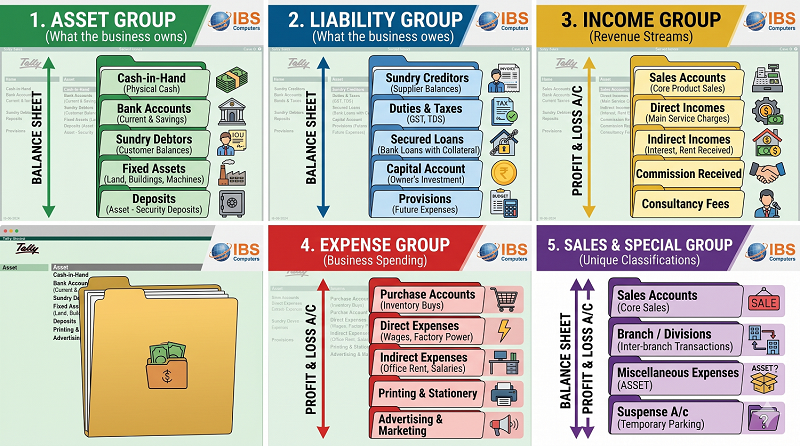
1. Asset Groups (What the business owns)
- Bank Accounts: For your standard savings or current accounts.
- Cash-in-Hand: Specifically for physical cash or petty cash ledgers.
- Current Assets: A broad category for assets that can be converted to cash within a year.
- Deposits (Asset): For security deposits (like electricity, rent, or fixed deposits).
- Fixed Assets: For long-term items like land, buildings, machinery, and furniture.
- Investments: For money put into shares, bonds, or mutual funds.
- Loans & Advances (Asset): Money you have lent to others (employees, sister concerns).
- Misc. Expenses (ASSET): Used for "Deferred Revenue Expenditure" like huge legal costs that are written off over years.
- Sundry Debtors: For customers who owe you money for goods or services sold on credit.
- Tangible: A sub-group of Fixed Assets for physical items (Assets you can touch).
2. Liability Groups (What the business owes)
- Bank OCC A/c / Bank OD A/c: Open Cash Credit or Overdraft accounts (short-term loans from banks).
- Branch / Divisions: For tracking transactions between the head office and branches.
- Capital Account: For the owner's investment (equity) and drawings.
- Current Liabilities: Debts to be paid within a year (statutory dues, bills).
- Duties & Taxes: For all tax-related ledgers like GST, VAT, or TDS.
- Loans (Liability): General group for money borrowed by the business.
- Provisions: Money set aside for known future expenses (e.g., Provision for Audit Fees).
- Reserves & Surplus: Accumulated profits kept aside for future use.
- Retained Earnings: Profit that is held back in the business instead of being distributed.
- Secured Loans: Loans taken against collateral (like a home or car loan).
- Unsecured Loans: Loans taken without collateral (like a loan from a friend).
- Sundry Creditors: Suppliers to whom you owe money for goods/services purchased.
3. Income Groups (Revenue)
- Direct Incomes: Primary revenue earned from main business activities (e.g., Service charges for a service firm).
- Income (Direct): Same as above, usually used to categorize revenue for the Trading A/c.
- Indirect Incomes: Secondary revenue not from sales (e.g., Interest received, Rent received, Commission).
- Income (Indirect): Same as above; these appear in the Profit & Loss A/c.
4. Expense Groups (Spending)
- Direct Expenses: Costs directly linked to production or purchase (e.g., Wages, Freight, Factory power).
- Expenses (Direct): These affect the "Gross Profit" in the Trading A/c.
- Indirect Expenses: Operating costs not directly linked to production (e.g., Office rent, Salary, Electricity, Printing).
- Expenses (Indirect): These affect "Net Profit" in the Profit & Loss A/c.
- Purchase Accounts: Specifically for ledgers used to buy stock/inventory.
5. Sales & Special Groups
- Sales Accounts: For ledgers used to record the sale of inventory.
- Suspense A/c: A temporary "parking spot" for transactions where the nature of the entry is unknown.
Related Post
Similar Post